


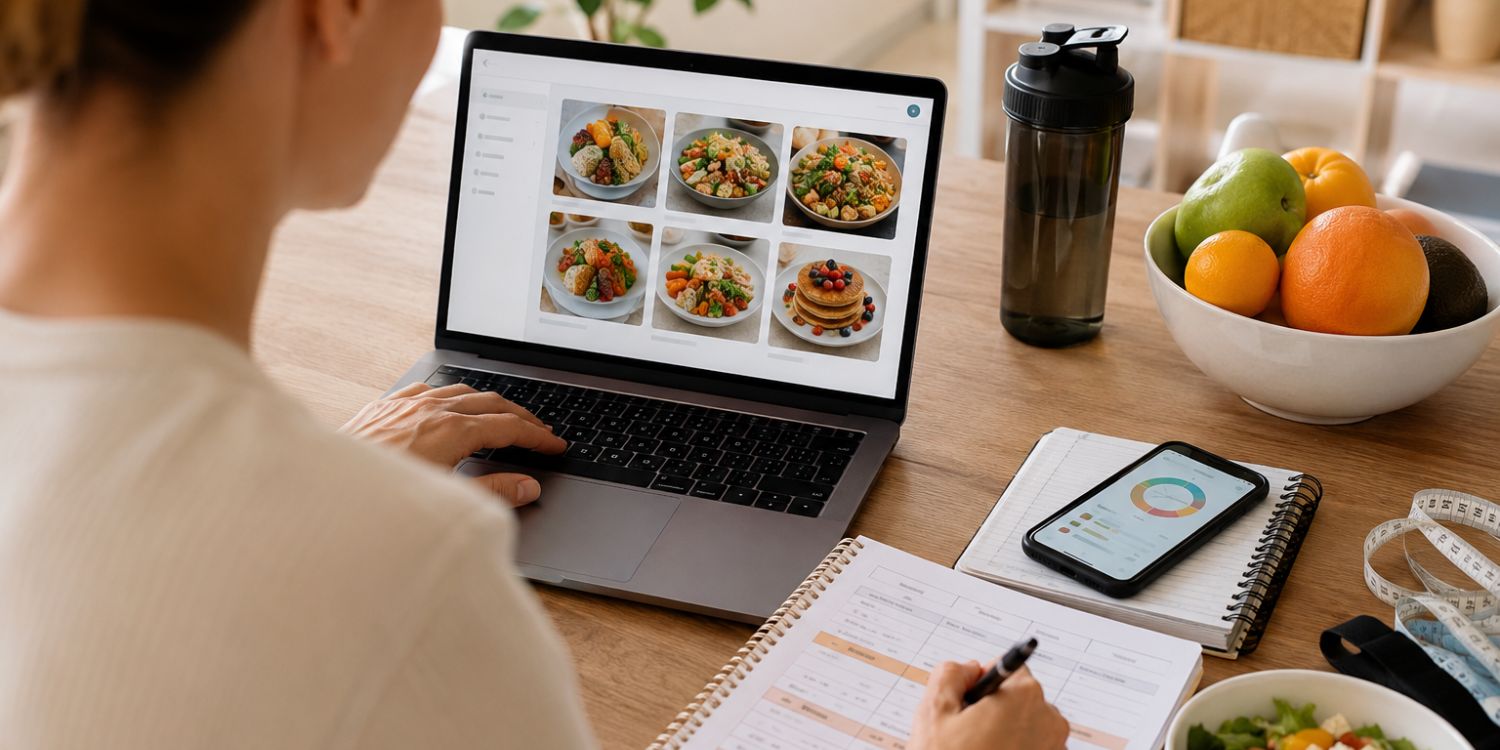
Creating a meal plan for one client is manageable. You calculate their energy requirements, consider their goal and preferences, and put together suitable meals.
But what happens when you are supporting not five, but twenty, fifty or one hundred clients?
Nutrition coaching can quickly become time-consuming. Do you need to create an entirely new meal plan for every client? How do you provide enough variety? What happens when clients have different calorie requirements, follow a vegetarian diet or simply dislike certain foods? And how much of your time as a coach do you really want to spend calculating and building menus? Fortunately, creating personalised meal plans for clients does not mean you have to build every menu manually from scratch.
Personalised nutrition coaching and doing everything by hand are two very different things.
What makes a meal plan personalised?
When you think about a personalised meal plan, you might imagine a completely bespoke menu where every slice of bread, gram of yoghurt and potato has been selected by the coach.But that is not necessarily where the most important personalisation happens.
A good meal plan starts with the right framework. This includes the client’s goal, energy requirements, food preferences, meal structure and lifestyle. A woman who wants to lose weight, follows a vegetarian diet and prefers three main meals has different needs from a man who strength trains four times per week and wants to build muscle.
That requires personalisation. But it does not mean you then have to sit in front of a blank screen and invent dozens of different recipes for both clients.
You can personalise the framework without doing every part of the execution manually. That distinction becomes increasingly important when you want to provide nutrition coaching to more clients.
How much time does it take to create meal plans manually?
Imagine you want to create a meal plan of around 1,800 calories. Putting together one day’s menu is relatively straightforward. But your client does not want to eat exactly the same thing every Monday. You need variety.One breakfast should be replaceable with another without completely changing the nutritional values. The same applies to lunches, dinners and snacks.
Then you have individual preferences to consider: no fish, vegetarian meals, no dairy or simple recipes for someone who has very little time to cook.
If you do all of this manually, you can quickly find yourself searching for recipes, calculating nutritional values and constantly adjusting menus. For a handful of clients, this is manageable.
But if nutrition coaching is going to become a serious part of your practice, gym or coaching programme, it becomes difficult to scale.
So the question is not simply:
How do I create a good meal plan?
An equally important question is: Which part of this process genuinely needs my expertise as a coach, and which part can nutrition software handle for me?
A perfect meal plan still doesn’t guarantee results
This may be the most important point. You can calculate a meal plan down to the last calorie and still have a client give up after three weeks.
Ultimately, the client has to put that plan into practice in real life. Perhaps they skip breakfast every morning because home life is too hectic. Maybe healthy eating works perfectly from Monday to Thursday but falls apart every weekend. Or perhaps they follow the meal plan exactly for two weeks and then feel they simply cannot maintain it any longer.
You do not solve that by creating an even more precisely calculated meal plan. That is where the coach comes in.
Where does your real value as a coach lie?
Not in deciding whether someone should eat 150 or 160 grams of potatoes. Your value lies in understanding what happens when the client tries to apply the advice in everyday life.
Why does lunch work during the working week but not at weekends? Why does someone become hungry every evening? Why are they struggling to eat enough protein? Is the plan too complicated? Or are they trying to do everything perfectly from day one?
Those are the conversations that create meaningful change.
A nutrition programme can calculate, structure and record information. But software does not automatically recognise that your client is slipping back into old habits after three weeks and needs a different approach. The software supports the nutrition coaching. The coach makes it personal.
What can you automate when creating meal plans?
Automation does not mean giving every client the same standard menu.Instead, you automate work that does not require you to reinvent the wheel every time.
This might include creating menus across different energy levels, offering enough meal variety and alternatives, calculating and displaying nutritional values, adapting plans to food preferences and recording what a client actually eats.
That gives you more time to interpret the information. Knowing that someone eats an average of 65 grams of protein per day is data. Deciding whether that is appropriate for their goal and finding a practical way to improve it is coaching.
A standard meal plan is not the same as a strong foundation
Working more efficiently also does not mean giving every client the same plan.You still need to choose the nutrition approach that best fits the individual.
For one client, a nutrition programme based around hormone balance may provide a suitable foundation. Another client may require a different energy or protein distribution because of their sport or specific goal.
So the question is not: Which standard meal plan can I give this client?
It is: Which nutrition approach suits this client, and how much coaching do they need to follow it successfully?
From 5 to 50 nutrition clients
When you support five clients, you can handle a lot manually. At fifty clients, things become very different.
If you create every menu yourself, calculate nutritional values and constantly search for alternatives, your workload increases almost directly in line with your number of clients.That is where professional nutrition software becomes valuable.
With BenFit, you can offer nutrition coaching without creating a completely new meal plan from scratch for every client. You select an appropriate nutrition programme and energy level while taking different goals and preferences into account. Clients then access their nutrition programme, meals and recipes through the app. They can also track their own food by searching for products, scanning barcodes or registering meals using a photo.
This gives you as a coach greater insight into what is actually happening outside the coaching session.
Nutrition software makes coaching scalable
This becomes particularly valuable for professionals who want nutrition to be a consistent part of their services. As a personal trainer, you may want to add nutrition coaching alongside your training. As a weight-management coach or dietitian, you may want to spend less time repeatedly creating menus. And as a gym, you may want to provide nutrition support to dozens or hundreds of members without building a completely separate process for every person.
In that situation, the nutrition advice itself is not the only thing that needs to work.
The process behind it needs to be efficient too. If ten additional nutrition clients automatically create ten times more work, you may generate more revenue, but you have not necessarily created a better business model. With the right nutrition software, part of the practical workload can be automated while the coach remains responsible for personalised guidance. That is the difference between simply handing out meal plans and delivering professional nutrition coaching.
Create personalised meal plans with BenFit
BenFit is designed for professionals who want to offer nutrition coaching without manually creating everything for every client. You can combine nutrition programmes, recipes, food tracking and coaching within one system. BenFit can also be offered in your own branding, making nutrition coaching a recognisable part of your own service. That means spending less time repeatedly building meal plans and more time on the part where your professional expertise makes the biggest difference:
understanding why a client is struggling and knowing what they need to move forward.
With the BenFit app, tracking nutrition is simple, practical, and easy to maintain in daily life. Curious how the BenFit nutrition programme can support your clients? Click here to learn more.