


Creating nutrition plans, sending recipes, monitoring progress, processing check-ins and motivating clients: when you’re supporting multiple people with their nutrition, these tasks can quickly become time-consuming. Good nutrition software can make much of this process more organised and efficient.
But which platform is right for the way you work?
One coach may primarily want a quick way to create personalised nutrition plans. A gym might want to give hundreds of members access to nutrition support. Another professional may be looking for an app that allows clients to track their own food intake.
Choosing nutrition software therefore isn’t about finding the platform with the most features. It starts with deciding what you want to achieve with it.
Here are eight points to consider when making your choice.
1. Does the software suit the way you coach?
Don’t start with a list of features. Start with your own service. How do you want to offer nutrition coaching?
Perhaps you give every client a personalised nutrition plan and regularly review their progress. Or you may prefer to give clients plenty of freedom to track their own food and only step in when adjustments are needed. A gym may have different requirements again. You might want to make nutrition support easily accessible to a large group of members, while a smaller proportion choose more intensive coaching.
Choose software that supports different coaching models rather than dictating how you should coach.
2. How personalised can you make the nutrition coaching?
Personalised coaching doesn’t mean you have to create everything from scratch for every client. Good nutrition software helps you work efficiently while still taking individual goals, preferences and needs into account. Look at features such as personalised nutrition plans, different dietary approaches, portion sizes, meal alternatives and recipes.
The easier it is to adapt your approach to the person you’re coaching, the better the software supports genuinely personalised coaching.
3. Is it easy for clients to use?
You might love a particular system as a coach, but if your clients find it complicated, they’re unlikely to use it consistently. Don’t just assess the coach portal. Pay close attention to the client’s experience too.
Can clients easily view their nutrition plan? Are recipes easy to find? Can they track their food? Is there a shopping list? Does everything work smoothly on a smartphone? Features such as barcode scanning and photo recognition can also make food tracking more accessible.
Digital tools and apps are playing an increasingly important role in fitness and coaching. The annual fitness trends from the American College of Sports Medicine (ACSM) also show that mobile fitness apps have an important place within the industry.
Ease of use for the client is at least as important as functionality for the coach.
4. How much time will it actually save you?
One of the main reasons for using nutrition software is efficiency. Start by looking at which tasks you’re currently handling manually.
Do you create nutrition plans yourself? Send recipes via WhatsApp? Track measurements in Excel? Manually make changes when a client doesn’t like a particular food? Good software brings as many of these activities as possible together in one place. The aim isn’t to automate coaching completely. Instead, practical and repetitive tasks can be supported digitally, giving you more time for personal interaction.
5. Can the software grow with your business?
A platform that works well for one coach with twenty clients isn’t necessarily suitable for an organisation with several locations and hundreds of participants. It’s therefore worth thinking ahead. Can multiple coaches use the platform? Can you easily add new participants? Can different coaching models operate alongside one another? And do the costs remain sensible as your number of users grows?
Scalability is particularly important if you want to turn nutrition coaching into an additional revenue stream. After all, you don’t want every new client to automatically create the same amount of additional administration.
6. Does it integrate with software you already use?
The more separate systems you use, the greater the chance that information ends up scattered across different platforms. Integrations can therefore be an important consideration. For gyms in particular, it can be useful if nutrition software works with fitness, membership management or health platforms that are already being used within the organisation. This can reduce duplicate work and make it easier to integrate nutrition into the existing client journey. So don’t just look at what the nutrition software can do today. Consider the wider ecosystem around it as well.
7. Does it fit your brand?
Ultimately, the app is something your clients will use. That means its appearance matters too. Can you use your own logo, colours or other brand elements? Does the app feel like a natural part of your own service?
This may be less important for an independent coach. For a gym or organisation offering its own complete coaching concept, personalisation can add significant value. A nutrition app doesn’t have to feel like a separate third-party product. It can become part of your own client experience.
8. What support do you receive after getting started?
A nutrition platform can offer plenty of features, but you still need to know how to use them effectively in practice. Ask what happens after you become a customer.
Is onboarding provided? Can coaches learn how to use the platform? Is support available if you get stuck? And is the software continuously developed? Good implementation is particularly important when several coaches will be working with the same system. After all, even the best software offers little value if only a small proportion of its functionality is actually used.
Look beyond price alone
Price naturally plays a part when choosing nutrition software. But simply comparing monthly fees doesn’t tell the whole story. A cheaper system may ultimately cost you more if coaches have to spend extra time carrying out manual tasks every week.
Instead, consider the balance between cost, functionality, time savings and the value you can provide to clients. If you’re charging for nutrition coaching, another question becomes relevant too: how much revenue could the software help you generate? In that situation, software isn’t simply a cost. It can become part of your service and business model.
Which nutrition software is right for you?
There isn’t one nutrition platform that’s automatically the best choice for every coach or gym. An independent nutrition coach has different requirements from a personal trainer. And a gym with hundreds of members will have different expectations around scalability, management and integrations.
First decide how you want to offer nutrition, then compare which software best supports that approach.
At a minimum, consider:
- how well it fits your coaching model
- personalisation options
- ease of use for clients
- time savings for coaches
- scalability
- integrations with other systems
- branding options
- onboarding and support
BenFit as nutrition software for professionals
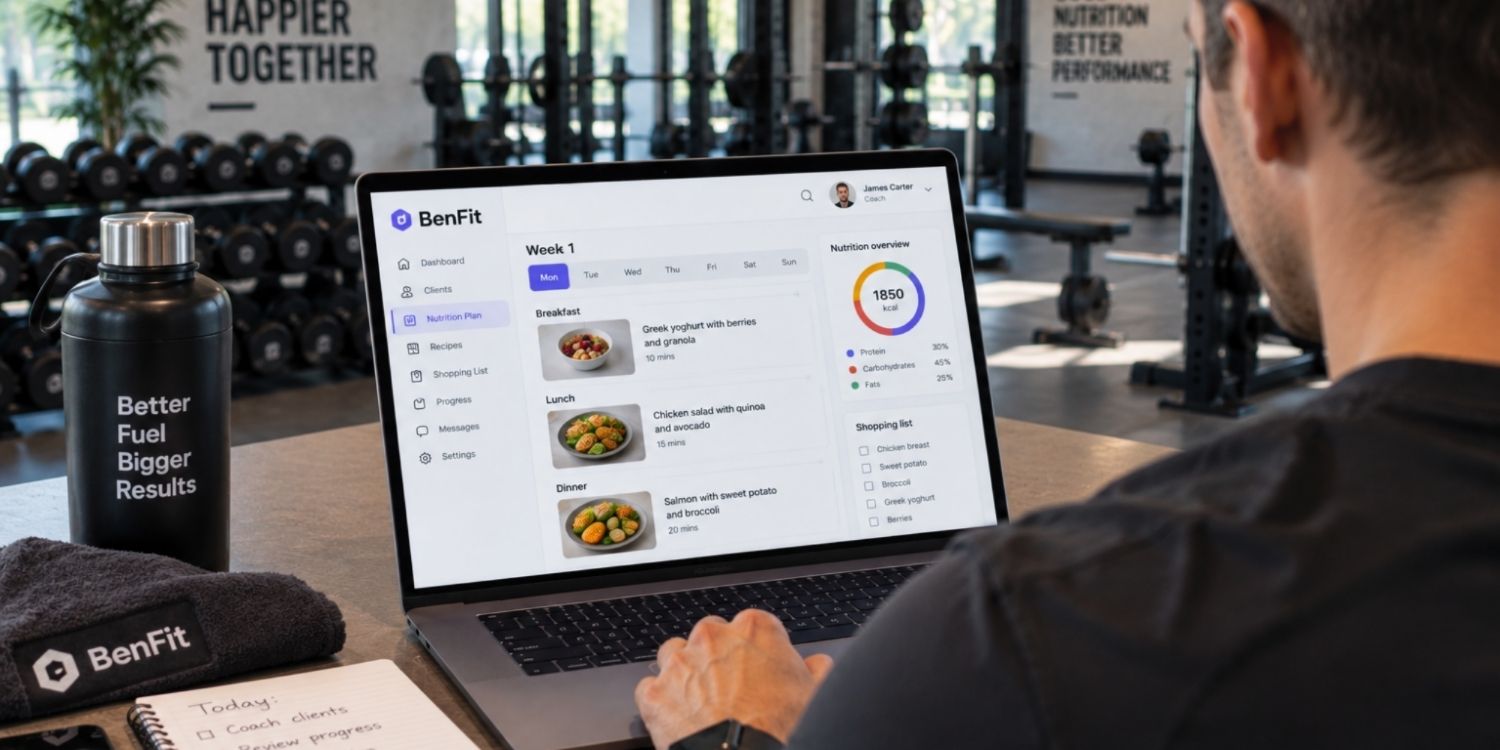
BenFit is designed to support gyms, personal trainers, nutrition and lifestyle coaches and other professionals with nutrition coaching. From one platform, you can work with personalised nutrition plans, more than 2,000 recipes, meal alternatives, shopping lists, progress tracking and food tracking using barcode scanning and AI photo input. You decide how intensively each person is supported – from clients who work largely independently on their nutrition to complete personalised coaching programmes. BenFit also offers personalisation options and integrations with various platforms across the fitness and health industry.
Ultimately, the best way to discover whether nutrition software suits the way you work is to experience it for yourself.
Want to see how BenFit works and discuss how you could use it within your services?
With the BenFit app, tracking nutrition is simple, practical, and easy to maintain in daily life. Curious how the BenFit nutrition programme can support your clients? Click here to learn more.